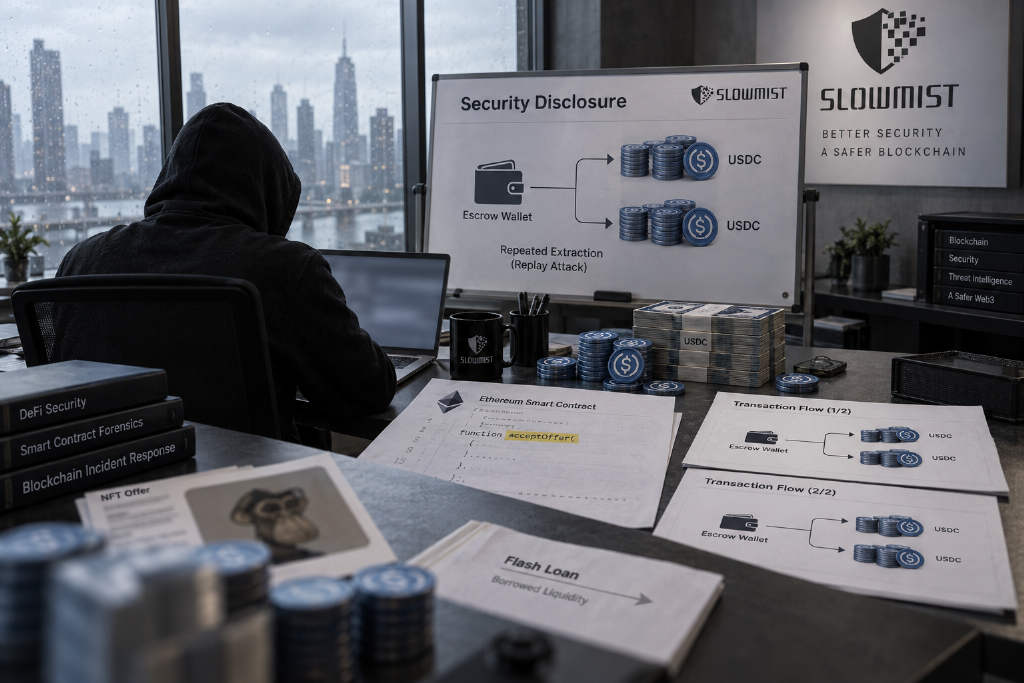
SlowMist2026-09-22 09:03:30SlowMist says DoinGud contract flaw let attacker replay transactions and net about 35,380 USDCSlowMist disclosed a logic flaw in a DoinGud smart contract that allowed an attacker to replay the same transaction data and withdraw funds multiple times. The issue was tied to the contract’s acceptOffer function, where the security firm said protections against duplicate transactions were missing and required state-cleanup checks were not in place. According to the disclosure, the attacker used two replayed transactions to drain all 70,973.871434 USDC held in the contract’s escrow account, ending with a profit of about 35,380 USDC. SlowMist also said the attack was funded with a flash loan, and that the attacker supplied neither any NFT nor any principal of their own. The vulnerable contract address was identified as 0x123aafc8d0a07ce1a146e53aa899e77f21a2dde1, while the attacker address was listed as 0xb8c717239bcace558c3a8dc471c16e07bf57a1eb. The disclosure was cited by Techub News and attributed to @SlowMist_Team.480
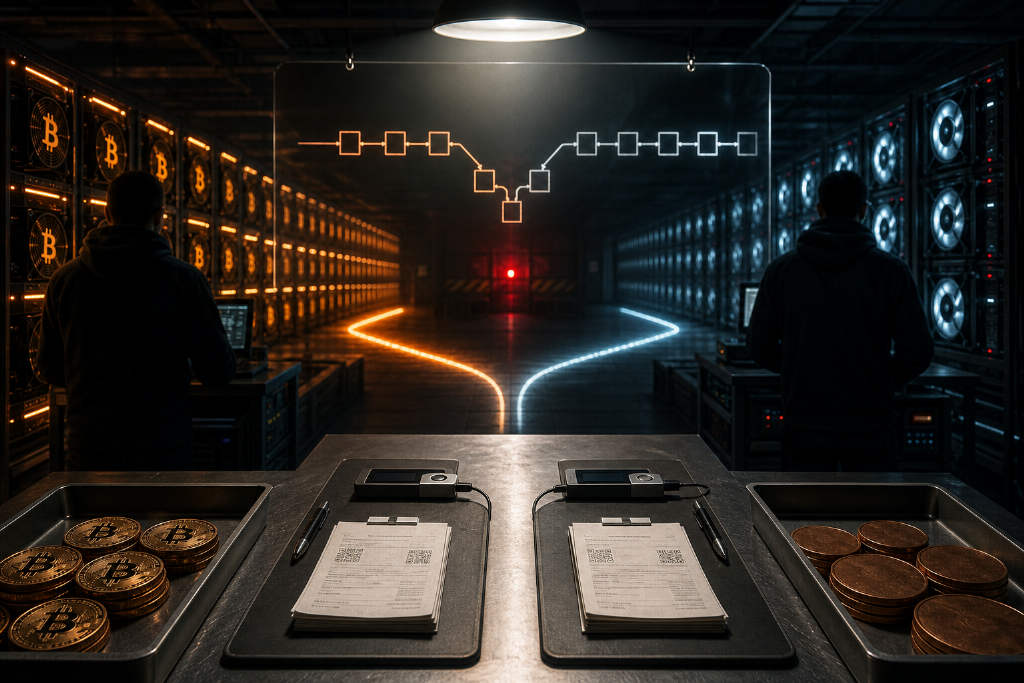
Bitcoin2026-09-06 17:19:10BTCB2 touched $1,799, implying a fully diluted valuation of about $20.9 billion at $1,000Bitcoin fork asset BTCB2 briefly reached an all-time high of $1,799 on Sept. 5, according to the news item cited by Odaily. Over the past four hours, the token traded between 750 and 1,000 USDC, while the Neoxa USDC market posted roughly $1 million in 24-hour volume. Using a BTCB2 price of $1,000, the project’s fully diluted valuation comes out to about $20.9 billion. BTCB2 stems from a chain split that took place on Aug. 8, 2026, at block height 961632. The network later switched its proof-of-work algorithm to Blake2 and reduced block size, making it minable with Blake2-compatible ASIC machines. BTCB2 is now listed on Neoxa Exchange, which offers BTC, USDC and USDT pairs, and on Nonkyc.io, which offers a USDT pair. The report said liquidity on both venues remains limited, and the asset has not yet been listed by CoinMarketCap or CoinGecko. It also noted an operational risk for holders: UTXOs need to be split from Bitcoin first, otherwise transactions may face replay attacks. Over the last seven days, the network’s hashrate rose 30.41% to around 5.1 PH/s, according to Bitcoin.com News.1030
BIP-1102026-08-20 00:26:50BIP-110 backers weigh a BLAKE2b fork to revive the minority chain as replay risks draw scrutinySupporters of BIP-110 are discussing another hard fork that would switch the stalled minority chain’s mining algorithm from SHA-256d to BLAKE2b. The issue drawing the most attention is replay risk: both chains still share transaction history from before the split, and if transaction and signature rules stay aligned, the same transaction could be copied and executed on the other chain. BIP-110’s miner support peaked at about 2.53%, and after the consensus rules took effect on Aug. 8, the minority chain produced only two consecutive blocks before stalling while the Bitcoin main chain continued and widened the block-height gap. The BIP-110 proposal was later marked closed, and discussion shifted to a BLAKE2b proof-of-work approach. Bitcoin Knots plans to add a new signature hash option, but RDTS is expected to keep compatibility with Bitcoin Core’s existing signature hash types. That means ordinary transactions may still remain valid on both chains, leaving users dependent on the new option and on wallets or hardware-signing firmware that support it in order to separate assets. Luke Dashjr said on Aug. 18 that Bitcoin should take responsibility for replay protection, calling it “Spamcoin.” If a BLAKE2b fork moves forward around Sept. 1, exchanges, wallets and holders would need to distinguish between cross-chain transactions and chain-specific ones.1290
SlowMist2026-08-09 11:21:35SlowMist's Cos Says No Need to Warn About Replay Attacks for Failed BIP-110 ForkOdaily reported that Cos, also known as Yu Xian from SlowMist, said in a post on X that there is no need to keep reminding users about replay attacks tied to the failed BIP-110 fork. The brief update did not include additional technical explanation, background on the fork, or any follow-up details beyond that statement. Based on the source material provided, the remark was limited to that point and did not expand on risk scope, timing, or related mitigation steps.1950
BIP-1102026-08-09 05:16:57BIP-110 Fork Chain Stalls After Mining Just 2 Blocks in 8 HoursJust two blocks have been mined on a minority Bitcoin fork run by BIP-110 supporters over an eight-hour stretch, and the chain has since stalled. In that same period, Bitcoin's main chain produced 48 blocks, showing how far apart the two networks are. BIP-110 is a proposal that would temporarily forbid the storage of non-financial data, including images and plain text, in Bitcoin transactions. Proponents say this could ease network congestion and bring down transaction fees. Critics argue that the change would prevent users from doing what they like with block space they have already paid for. The fork chain currently draws only 2.53% mining support, a level so low that block production is extremely slow and meeting the signaling deadline looks difficult. There is also a caution for users: selling the forked tokens while spending main-chain bitcoin could expose them to a replay-attack-like risk. The details come from Odaily's report.1870
Bitcoin2026-08-08 02:32:06BIP-110 Fork Replay Attack Risk: Selling Forked Coins Could Spend Real BitcoinAccording to Odaily, a proposed Bitcoin fork tied to the controversial BIP-110 proposal may create duplicate balances on two chains. Holders could be tempted to sell what appear to be free forked coins. However, since both chains initially accept the same transactions, selling the forked coins could trigger a replay attack, simultaneously spending the seller's real Bitcoin on the main chain. Developers state that at least until early September, there is no built-in replay protection. Therefore, non-professional users should avoid transferring Bitcoin during the potential fork period. The report is based on CoinDesk's coverage, as summarized by Odaily's newsflash on Aug. 8, 2026. The update is categorized as market analysis.1800
Bitcoin2026-08-08 02:32:50Bitcoin Developer Warns of Replay Attack Risk in Potential BIP-110 ForkBitcoin developer Kevin Loaec has issued a warning about a possible bitcoin fork connected to the controversial proposal BIP-110. If the fork happens this weekend, holders who sell the resulting forked-chain tokens may face the risk of having their real BTC stolen. The proposed fork could lead to duplicate balances existing on both chains. This might tempt holders to sell what appear to be free forked coins. However, during the initial phase, both chains accept the same set of transactions. As a result, selling forked coins could trigger a replay attack, where the seller's genuine bitcoin on the main chain is spent at the same time. The developer stated that there is no built-in replay protection, at least until early September. Therefore, non-professional users should avoid moving bitcoin during the potential fork. This warning highlights the danger of interacting with forked assets without proper safeguards.1850
Polkadot2026-07-08 20:14:14Polkadot Price Dips 6% After 1 Billion Token Minting Exploit on Ethereum via Hyperbridge GatewayCertik reported a replay vulnerability in the Hyperbridge gateway that allowed an attacker to mint 1 billion unauthorized DOT tokens on Ethereum. DOT price fell 6% to $1.16, with the hacker profiting $237K in ETH. Only the Ethereum bridge was affected; Polkadot's relay chain remains secure.560